
Introduction
Understanding the true health status of your mouth requires overcoming some of the most deeply rooted misconceptions in oral healthcare. Many severe oral pathologies do not announce themselves with acute pain or obvious macroscopic signs; instead, they operate silently below the surface for a long time. Learning to recognize the hidden dangers behind an apparent normal state is the essential first step toward preventing otherwise irreversible structural damage.
The Myth of “If It Doesn't Bleed, Everything Is Fine”
In daily clinical practice, we frequently welcome patients who are surprised and disoriented by a diagnosis of advanced periodontitis. The most common reaction is perplexity: people tend to equate oral health with the absence of bleeding during brushing or flossing. This belief creates a false sense of security that leads individuals to postpone routine checkups, unaware that deep tissues can suffer completely painlessly.
The Invisible Threat of Silent Bone Loss
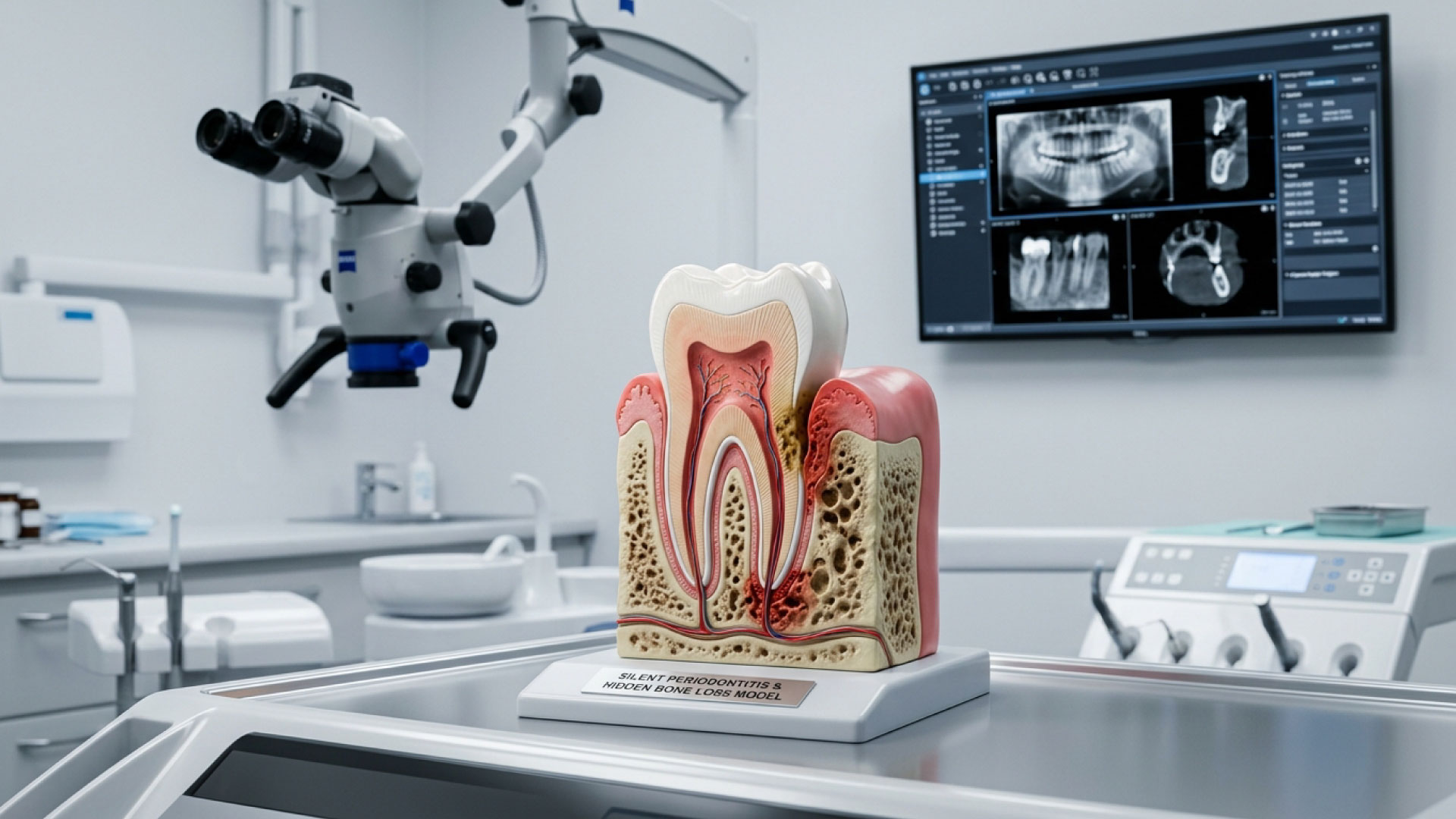
There is a creeping danger capable of destroying the supporting structure of the tooth without triggering classic inflammatory warning signs. Silent-progression periodontitis gradually erodes the alveolar bone and periodontal ligament while leaving the gums looking deceptively healthy and firm on the surface. Recognizing this pathology demands a shift in perspective: an absence of blood in the sink does not guarantee oral health—it may conceal deep, irreversible bone loss.
Silent-Progression Periodontitis: How It Manifests
The way periodontal disease develops can vary significantly from person to person, creating a highly diverse clinical presentation. When the pathology departs from classic inflammatory patterns to follow an insidious, hidden trajectory, tissue damage dynamics change radically. Examining these underground mechanisms helps explain why deep destruction can occur in the oral cavity without sending out standard red flags.
Diagnostic Challenges Compared to Classic Gingivitis
Unlike conventional gingivitis—characterized by swollen, reddened tissue prone to bleeding at the slightest touch—silent periodontitis alters deep structural anatomy while keeping the surface deceptively intact. Anaerobic pathogenic bacteria settle into the subgingival environment, carving out deep periodontal pockets where they proliferate beyond the reach of a toothbrush. Without a targeted clinical evaluation, the infection progresses quietly, destroying anchoring fibers without causing acute pain or visible bleeding.
The Evolution and Risks of Unnoticed Bone Destruction
The true danger of this variant lies in its continuous, unabated progression. Chronic destructive inflammation stimulates a resorptive response in the underlying bone. Month after month, the height of the alveolar crest diminishes, reducing the foundational support of the teeth. Because this process occurs without macroscopic swelling, patients typically notice the problem only when marked tooth mobility appears or when teeth begin to drift, creating abnormal gaps—stages at which the clinical situation is already severely compromised.
Systemic Risk Factors
The health of your gums and alveolar bone does not depend solely on home oral hygiene practices; it is heavily influenced by the body’s overall systemic balance. Certain general health conditions, lifestyle habits, and biological predispositions can profoundly alter vascular and immune responses in oral tissues. Analyzing these vulnerability factors is key to understanding why an infection can advance without typical surface symptoms.
The Role of Smoking, Stress, and Vasoconstriction
To understand why bleeding might be completely absent, one must analyze the impact of systemic risk factors on blood vessels. Nicotine and tobacco combustion byproducts exert a powerful vasoconstrictive effect on gingival capillaries, reducing blood flow and masking the primary inflammatory response. Similarly, high levels of chronic stress impair local microcirculation and immune function, resulting in a visually normal gingival appearance that conceals deep, active tissue destruction.
Diabetes, Genetic Predisposition, and Immune Dysregulation
Metabolic disorders and hereditary factors also play a decisive role. Uncontrolled diabetes mellitus alters the host’s inflammatory response, accelerating bone resorption and disrupting normal tissue repair signals. When combined with a genetic predisposition toward an hyper-reactive immune response against bacterial plaque, bone resorption proceeds at an accelerated pace, regardless of how little plaque is visible on the outside.
Diagnosis Through Probing and Targeted X-Rays
When a pathological condition evades direct visual observation, a standard visual checkup proves insufficient to establish an accurate clinical profile. Uncovering what occurs beneath the gumline requires high-precision diagnostic and functional investigative tools. Only through a rigorous, structured diagnostic protocol is it possible to measure the true extent of the supporting tissues and intercept the disease before it manifests dramatically.
The Deception of Absent Symptoms and Misleading Signals
What makes invisible periodontitis such a puzzle for patients is the lack of prolonged pain. Unlike deep cavities or acute abscesses that cause localized, sharp pain, silent periodontal loss generates mild, elusive sensations: a vague feeling of pressure during chewing or subtle bad breath. This intermittent, subtle nature leads people to dismiss small changes, convincing themselves that specialist care is unnecessary.
Periodontal Probing and Endoral Radiographs to Unveil the Invisible
Overcoming this diagnostic barrier requires strict protocols. During an examination, a periodontal probe is used to measure the depth of the gingival sulcus millimeter by millimeter, identifying hidden pockets even in the absence of bleeding. This is paired with an endoral radiographic status—a set of targeted, low-dose radiographs providing a precise map of interdental bone heights, allowing clinicians to visualize the exact extent of bone loss that remains invisible to the naked eye.
Professional Therapies and Maintenance
Once silent-progression bone loss is identified, the treatment plan must aim for deep disinfection and immediate disease arrest. Saving compromised teeth requires an integrated clinical approach combining targeted decontamination procedures with ongoing long-term monitoring. Effective management relies on the synergy between in-office clinical procedures and a personalized long-term follow-up program.
Root Planing and Subgingival Bacterial Decontamination
When silent periodontitis is intercepted, the primary objective is to stop the advancement of bone resorption immediately. The initial therapeutic approach involves root planing (scaling and root planing), performed with ultrasonic instruments and precision curettes. This treatment removes bacterial biofilm and hidden calculus from within the periodontal pockets, decontaminating root surfaces and creating the biological conditions necessary for tissue reattachment.
Personalized Periodontal Maintenance Plans for Long-Term Stability
Following initial treatment, preserving the results and remaining bone density depends on consistent maintenance. A personalized supportive periodontal therapy plan is established, with routine professional care scheduled according to the individual’s risk profile. Thorough professional cleaning, combined with advanced biofilm removal techniques and optimized home care, stabilizes tissue health and prevents the disease from quietly reactivating.
Conclusion
Living with silent periodontitis without knowing it poses a major threat to the long-term survival of your teeth. The absence of bleeding should never be interpreted as a guarantee of complete gum health. Early diagnosis—supported by clinical probing and targeted radiographs—is the only true defense to halt bone loss before tooth stability is permanently compromised. Scheduling regular specialist checkups is the essential step to protect your smile and preserve its underlying foundation for years to come.