Our skeletal system, including the maxillary and mandibular jawbones that support our teeth, undergoes continuous remodeling throughout our lives. As the years pass, this biological self-renewal process can experience shifts, especially if teeth were lost in the past and not replaced in a timely manner. Understanding the biological mechanisms behind resorption is the first step toward addressing it without unnecessary anxiety.
The bone surrounding our teeth (alveolar bone) exists for one single purpose: to support dental roots and absorb the mechanical forces of chewing. When a tooth is extracted or lost, that daily mechanical stimulation vanishes, and the body—interpreting that specific tissue as no longer necessary—begins to reabsorb it. This atrophy phenomenon, known as jawbone loss dentistry, can also be influenced over time by natural shifts in cellular metabolism, physiological hormonal changes, or chronic inflammatory conditions such as long-neglected periodontal disease.
The progressive loss of bone support does not just threaten the stability of any remaining teeth; it can also alter the natural harmony of the face. Without the underlying bone structure, soft tissues like the lips lose their natural support and tend to collapse slightly inward, accentuating expression lines around the mouth. Functionally, this lack of stability makes chewing less efficient, restricting your freedom to choose what you eat and heavily impacting your shared social moments around the dinner table.
At our practice in Paphos, we are very frequently asked one direct question: “Dr. Lenia, am I too old for dental implants?”. Many patients around their 60s fear that their organism will no longer respond or heal as it used to, but modern dental science proves the exact opposite through daily, long-term clinical success stories across all adult age groups.
What ultimately determines success in implantology is not the number of candles on your birthday cake, but your overall systemic health and tissue quality. A person in their 60s or 70s who enjoys good general health, maintains an active lifestyle, and keeps their vital parameters well-regulated responds to implant treatments exactly like a 30-year-old. The bone tissue’s ability to fuse securely with titanium (osseointegration) remains highly efficient and powerful throughout life, provided that top-tier clinical protocols are strictly applied.
Choosing to invest in a solution with fixed teeth after 50 is a smart, long-term preventive choice for your entire body. Traditional removable dentures, while being an immediate quick-fix, tend to rest directly on the gums, paradoxically accelerating the resorption of the underlying bone due to unstable, shifting pressures. On the contrary, implants restore the correct mechanical stimulation to the jawbone during chewing, actively helping to preserve the remaining bone volume while returning the total freedom to speak and smile completely worry-free.
When a patient presents with a reduction in bone volume caused by years of missing teeth, we do not view it as an insurmountable barrier. Scientific research now equips us with a suite of advanced surgical and engineering solutions specifically designed to resolve cases of atrophy, significantly reducing the invasiveness of the treatments.
Modern implantology has developed specific minimally invasive techniques to place titanium posts even in severely reduced bone volumes. Through the use of latest-generation short implants or the strategic tilting of perni (as seen in All-on-4 or All-on-6 methods), we can anchor a new permanent set of teeth by utilizing areas where the bone is naturally denser and more compact. This approach allows us to bypass, in the vast majority of cases, the lengthy waiting times and discomfort associated with the massive bone grafts of the past.
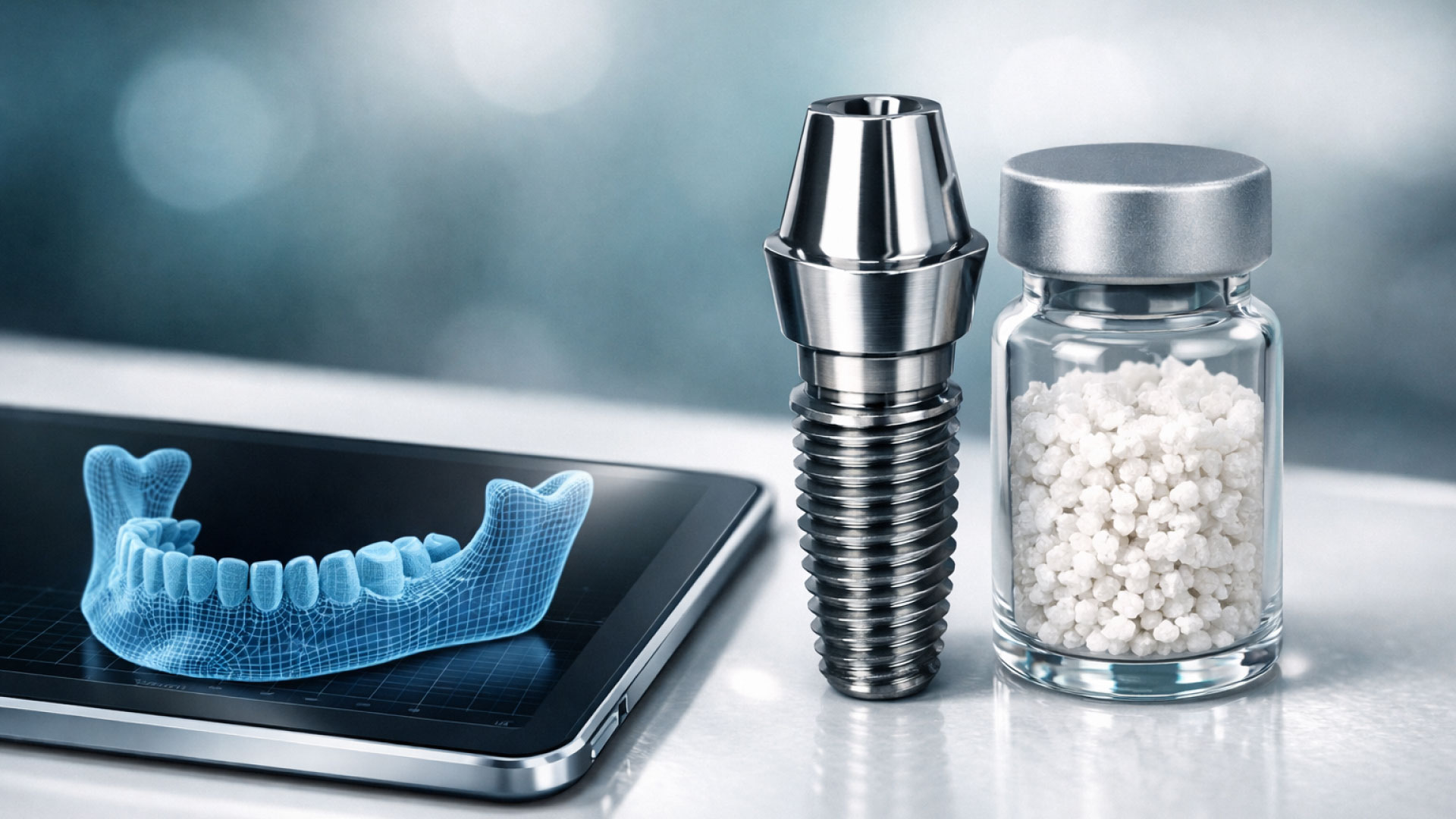
In cases where it is absolutely indispensable to locally increase bone volume to guarantee the long-term stability and duration of the implant, we utilize Guided Bone Regeneration. This procedure involves placing biocompatible biomaterials protected by specialized resorbable membranes, which act as a blueprint for the body’s cells. The organism uses this scaffolding to generate healthy, vital new bone tissue within a few months. These are highly standardized, routine interventions performed under local anesthesia with an extremely smooth and calm post-operative recovery.
The secret to achieving a perfect, durable, and surprise-free result lies in millimeter-precise planning carried out well before the procedure begins. At our Paphos dental clinic, we constantly invest in top-tier three-dimensional diagnostic technologies to map out the patient’s mouth with absolute precision.
To evaluate the exact extent of jawbone loss dentistry, we utilize Cone Beam Computed Tomography (CBCT). This latest-generation 3D X-ray examination operates at a ultra-low radiation dose while providing us with a flawless, multi-angle view of the mouth’s entire skeletal architecture. It allows us to measure the exact thickness, height, and density of the available bone, pinpointing the location of crucial anatomical structures (such as nerves and maxillary sinuses) to plan a 100% safe insertion.
The three-dimensional data from the scan is processed using digital simulation software, allowing us to virtually design the ideal placement for each individual implant. From this digital project, we create a custom surgical guide that directs our hands during the actual procedure, eliminating the need for large surgical incisions. This guided surgery is ideal for anyone looking for a swift treatment, as it minimizes the need for stitches, virtually zeroes out post-operative swelling, and accelerates healing times.
Safeguarding your overall health is the central pillar of every therapy we offer. When planning an implant procedure in the presence of bone resorption on a mature patient, we adopt a rigorous safety protocol that reviews the individual’s global medical history to guarantee a fluid, complication-free journey.
Before initiating any treatment, we conduct a thorough medical history assessment to evaluate conditions common in middle age and beyond, such as mild forms of diabetes, hypertension, or the initiation of bone density therapies. We regularly collaborate with our patients’ primary care physicians to check any ongoing medications (such as anticoagulants or bisphosphonates), scheduling the procedure at the most ideal time and in total safety for the entire body.
The longevity of a dental implant is directly tied to the care and attention it receives after placement. We provide clear, personalized guidelines for correct home hygiene and scheduling maintenance visits. At our practice in Paphos, we establish a tailored calendar for routine professional hygiene sessions: a healthy, clean mouth monitored by professionals is the one true secret to making your new fixed teeth last a lifetime.